Saturday, 12 January 2013

Nokia Lumia 920: What it looks like

Nokia has unveiled Lumia 920 packed with competitive hardware and finest optics to produce quality imaging.
Nokia Lumia 920
Nokia has launched its much anticipated Windows Phone 8 based Lumia 920 smartphone in India for Rs 38,199 (Available at around 35k in market). Though loaded with many latest features, the most interesting feature in this handset is the inclusion of Nokia's PureView Camera imaging technology with the Carl Zeiss lens.

Nokia Lumia 920 physically appears to have the same design as Nokia N9, Lumia 800 and Lumia 820 but with minor changes. When shut off, the Lumia 920 may mislead to Lumia 900 but infact is slightly bigger than the latter. Thanks to Nokia I got my hands on a red color chassis bearing Lumia 920 for almost a day. Unfortunately, I was informed not to use micro SIM with the Lumia 920. Even if I tried, it would have been pointless for the hands-on experience took place in a place, where the cellular network is pathetic.

Here are some of my thoughts on brief interaction with the Nokia Lumia 920 smartphone.

Nokia Lumia 920 Design
Design
Nokia has used the same unibody polycarbonate clamshell design as with its earlier generation of Lumia handsets. Since the earlier designs were happily accepted by the buyers, the manufacturer hopes the same reception will be given to Lumia 920.

The Lumia 920 has an external unibody shell made of polycarbonate. Hardware is compactly packed inside this unibody polycarbonate shell with the LCD touchscreen display on the top. On the top rests the standard 3.5 mm audio port in the middle and next to it as a Micro SIM slot tightly shut. There is no micro SD card slot on the top like the one present in Lumia 800.
Nokia Lumia 920 Design
Stereo speakers are located at the bottom in the form of small drill holes. The micro USB port lies between those speaker grills. Also, the bottom has the two star head top bearing screws which clamp the screen panel to the chassis.

3 capacitive buttons -- Back, Start and Search, are positioned on the front panel at a finger's distance from the bottom end. On the right side are the physical function keys designed from ceramic and are really very responsive. Nokia claims those keys are resistant to normal wear and tear to offer longer usage life. At the top of side panel rests the volume control buttons, below that is the power/sleep/wake-up button and a dedicated camera button shines at the bottom.
Nokia Lumia 920 Design
Flat top and bottom of the phone will keep the phone stand upright. Curved sides enable getting better grip while holding the phone. The glossy finish gave Nokia Lumia 920 premium look and feels really nice in the palms. In comparison, Matte finish designs are great for those who don't want to worry about scratches and fingerprints on their handsets.

Nokia Lumia 920 feels really smooth when held and red color makes it look like a model of Ferrari.
Nokia Lumia 920 Hardware
Hardware Muscle
Nokia Lumia 920 runs the new Microsoft Windows Phone 8 mobile operating system with preloaded Nokia's apps such as Maps, Music, City Lens and more. The Windows Phone 8 appears fantastic and crisp on the 4.5-inch LCD Display.

Nokia has used PureMotion HD+ on the 4.5-inch LCD ClearBlack Display that is little curved at the edges. This display provides good color reproduction and pleasing viewing angles even though it is not an Amoled display. The default resolution being 720x1280 pixels makes the text and images appear crisper.
Nokia Lumia 920 comes with PureMotion HD+ technologu
The PureMotion HD+ technology makes the display butter smooth and can be used even while wearing gloves. This display has been constructed using Gorilla Glass 2 technique that makes it slimmer and resistant to scratches during normal usage.

I found the display really good and responsive even to the finger nails. Packing superior resolution and pleasing visual feedback, this display certainly makes Windows Phone 8 experience more fluid and crisp.
Nokia Lumia 920 comes with a dual-core 1.5 GHz Qualcomm Snapdragon S4 'Krait' mobile process
The device comes packed with a dual-core 1.5 GHz Qualcomm Snapdragon S4 'Krait' mobile process tagged along comes Adreno 225 grahics chip. The manufacturer has added 1 GB RAM and offers 32 GB on-board storage. Since there is no microSD card slot, the only way one can get more storage is by using Cloud Servers based storage services.

Wireless connectivity is available with the 3G and LTE cellular network support. The device also boasts dual-band (2.4 GHz and 5 GHz) Wi-Fi support and Bluetooth 3.1 with A2DP/EDR. Of course, the smartphone does pack a Near Field Communications technology to stay compatible with several NFC-based accessories from Nokia.
Nokia has packed Lumia 920 with PureView Camera imaging technology
Camera
Nokia has managed to implement the PureView Camera imaging technology in the Lumia 920. This flagship Windows Phone 8 handset features 8.7 MP camera with f/2.0 aperture and Carl Zeiss lens. Dual LED powered Xenon Flash provides better luminance in low light situations. Nokia has added Optical Image Stabilisation technology which makes it stand out from the crowd.

Nokia has positioned the camera assembly on a shock absorbing movable platform inside the unibody polycarbonate chassis. So whenever the user tries image capture or video recording with slight shake of hands, there is no or minimal blurriness involved in the resultant image or video.

Also, I tested the camera's performance in low light conditions and felt blown away by the results. The Lumia 920's Camera could capture smooth details in very low light environment.

Infact in certain places there was no flash usage at all and the Lumia 920 provided good quality of images with natural color and lighting.

The Carl Zeiss optics has been smartly used to offer nice white balance and deliver very natural colors in close ups and land scape shots. I would love to play more with the camera.

The camera app user interface is smooth and pretty much linear to navigate through. Three software lens app come pre-loaded -- Smart Shoot, Panorama, and Cinematograph. The OIS also comes handy for recording videos in 720p and 1080p resolution.

There is also a front facing camera capable of supporting HD video chat.
Nokia Lumia 920 Review
Conclusion
Nokia Lumia 920 has been packed with powerful hardware and promising optics technology to deliver on of the best performance. Of course the phone has its own set of merits and minor demerits -- expect more on both in coming detailed review. Only thing that I missed out on was to test out Qi Technology powered wireless charging.

Anyways Nokia Lumia 920 is a premium package tailored to give subtle surprises.

The Chinese Smartphone Invasion Starts

China's Smartphone manufacturers Huawei and ZTE, looking to win U.S. buyers away from Apple and Samsung, showcase new smartphones at CES.
The Chinese Smartphone Invasion Starts
Tech biggies Apple, Google, and Microsoft were no-shows at CES this week in Las Vegas that proved to be just fine for Chinese manufacturers looking to establish a name for themselves with U.S. consumers. Telecom companies Huawei and ZTE, in particular, have set their eyes on breaking into the U.S. market for Smartphone and tablets.

That objective may seem little difficult – majority of consumers may remember that a select committee from the U.S. House of Representatives slammed Huawei and ZTE in October. The House report warned U.S. companies against using devices from Huawei and ZTE: "Based on available classified and unclassified information, Huawei and ZTE cannot be trusted to be free of foreign state influence and thus pose a security threat to the United States and to our information systems." During the same time, Cisco reportedly broke ties with ZTE after a year-long investigation into allegations that the company sold Cisco gear to Iran.

While the chances on a breakthrough may be long -- after all, Huawei has been unsuccessful in getting most U.S. carriers to offer its branded products -- the Chinese firms appear uncowed and confident. ZTE even had the guts to ding Apple in public last year, saying the slow pace of iPhone releases indicate that the iconic American company was losing its edge. The IDG News Service report notes:
While ZTE is 3 positions behind Apple as the world's fifth-largest smartphone supplier, according to research agency IDC, the Chinese company saw second-quarter smartphone shipments grow 300 % year on year. Helping to fuel that growth was the Chinese market, where ZTE narrowly beat Apple in market share by selling lower-end smartphones.
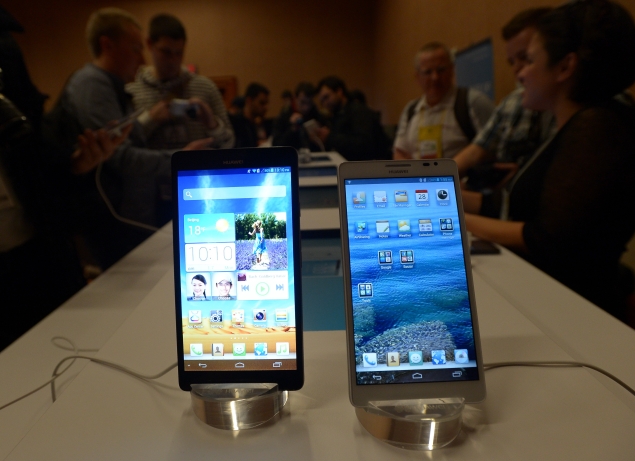
As part of Huawei's strategy to win the U.S. market -- which CEO Richard Yu calls "key" to the company's future -- Huawei launched two new smartphones this week at CES. The Ascend Mate has the world's biggest display; at 6.1 inches, it surpasses even the popular Samsung Galaxy Note II with its 5.5-inch screen and prompts Joel Evans at ZDnet to ask how big is too big for a smartphone. The phone runs Android 4.1 with a custom Huawei user interface, and its dust- and water-resistant feature has been cited as one of the five smartphone trends from CES. It also boasts an impressive 4,050mAh battery which should result in longer usage time between recharges.

Huawei also unveiled the Ascend D2 which the company claims is the world's most powerful smartphone. It sports a 5-inch 1080p display, a quad-core 1.5GHz CPU, Android "Jelly Bean," a 13-megapixel rear camera, and 3,000mAh battery.

ZTE also jumped on the big-screen smartphone bandwagon at CES, introducing a flagship Android phone with a 5-inch full HD display. The ZTE Grand S will be launched in China in early 2013, but ZTE said it is in talks with two carriers about selling the phone in the US. The Grand S is one of the thinnest smartphones available in the market at 6.9mm thick (the iPhone 5 is 7.6mm) and runs on the "Jelly Bean" version of Android and a quad-core 1.7GHz Qualcomm Snapdragon S4 Pro processor.

Whether these Chinese devices can take on the likes of Apple and Samsung remains to be seen, but as Wired quotes Jeff Lotman, the CEO of Global Icons, an agency which helps companies build and license their brands:
The thing that's amazing is these are big companies, and they have a lot of power, but in the United States nobody has heard of them and they're having trouble gaining traction, but it's not impossible. Samsung was once famous for making crappy, low-end phones and cheap TVs. Now they're seen as a top TV and smartphone brand.
Nothing is impossible!!!

Wednesday, 9 January 2013

CES 2013: Huawei is challenging Samsung, Apple with big-screen smartphones

Huawei Technologies boosted the competition in the smartphone display size and resolution on Monday with two new devices Ascend D2 and Ascend Mate. The new devices are aimed at challenging much bigger rivals, Samsung and Apple.
Soon to be released Huawei new smartphones Ascend Mate are presented at the 2013 International Consumer Electronics Show in Las Vegas on January 7, 2013
The Chinese phone manufacturer, which is pushing to expand its market beyond its home country, unveiled the Ascend D2 and Ascend Mate devices on the eve of the Consumer Electronics Show in Las Vegas.

The company said the Ascend D2 would have a high-definition screen with 443 pixels per inch compared with the top Samsung and Apple phones, with resolutions closer to the 300 pixels per inch range.

The Ascend Mate device has a 6.1 inch display that will make it the biggest-screen smartphone in the world, according to Huawei. Samsung's biggest smartphone to date, the Galaxy Note II, which has a 5.5 inch display.
"The company is hoping its latest smartphones will offer an alternative for people who have to carry around their tablet computer, laptop, smartphone and camera all at once."
Richard Yu, Head of consumer electronics, Huawei
"Our idea is whether we can have one thing for all that"
Richard Yu

The company intends to start selling the Ascend D2 in China in January and in Japan and other countries later on.

The Ascend Mate will be available in Chinese market in February and in the rest of the world in the following months.

Huawei also expects the phones to go for sale in Europe and said it is in discussion with U.S. operators about selling them here. It did not disclosed prices for the devices.

Monday, 7 January 2013

iPhone 5 is the worst of the Top Smartphones: Consumer Reports

One of the factors Apple's stock has gotten beaten lately is that many people think Apple has lost its superiority in its most important product line: smartphones.

iPhone 5
The iPhone has been such a great success story that it drives more than half of Apple's overall profit. And for most of the last 5 years, Apple has had a lock on the "best smartphone available in the market."

In recent years, however, competitors lime Samsung and HTC have caught up with the iPhone. Some experts think Samsung's new phone is superior to Apple's latest phone. And many people believe Samsung will leap ahead when the new Galaxy S4 comes out this spring.

Another reputed product reviewer, Consumer Reports, agrees with those who think Apple has lost its superiority.

In fact, Consumer Reports' final analysis is even more depressing for Apple fans.

Consumer Reports rates the iPhone 5 the worst of the top of the line smartphones.

CR doesn't disclose the reasoning for its numerical ratings (yet), but the results are still startling.
Below is the summary box of CR's tests that appears in the February issue of the magazine. The numerical ratings are close together, but they're unequivocal.

As you can see, on AT&T and Sprint, the iPhone 5 is rated behind 2 phones:
  1. The LG Optimus G (Android)
  2. The Samsung Galaxy S III
On Verizon, meanwhile, the iPhone 5 is rated beneath at least 3 smartphones:
  1. The Motorola Droid Razr Maxx
  2. The Motorola Droid Razr HD
  3. The Samsung Galaxy S III
iPhone 5 is the worst of the Top Smartphones: Consumer Reports
Not even ranked in the top three at Verizon? Positioned behind Google phones in addition to Samsung phones? That is really hard to digest.

We are entering ‘post-smartphone era’, says industry analyst

The era of the smartphones is fast becoming a post-smartphone era, a key technology industry expert has said.
We are entering ‘post-smartphone era’, says industry analyst
Shawn DuBravac, chief economist at the Consumer Electronics Association, said that the smartphone has become so successful it is become a hub for people''s digital lives, and less of a communications tool.

Ahead of Tuesday''s start of the International Consumer Electronics Show in Las Vegas, DuBravac said that ‘we are entering a post-smartphone era’.

According to the Herald Sun, he said 65 % of time spend on smartphones now is ‘non communication activities’ that include apps for health, entertainment or other activities.

He said that ‘we have moved away not only from telephony, but from communications being the primary part of these devices’.

So it is not just a communications tool anymore, it is a hardware hub around which people design services, the smartphone is becoming the viewfinder for your digital life, he added.

DuBravac said this is among the key trends being watched as tens of thousands gather to show off the latest devices in global trillion-dollar technology sector, the report said.

Another trend is the high-density screens that are being build for smartphones, tablets, computers and bigger devices such as televisions, it added.

Sunday, 6 January 2013

Tizen is the Blueprint Samsung can use against Android and Google

Here comes Tizen! Yes it is another new mobile operating system based on Linux. Yes it is another mobile OS which will be made available on a small number of devices, and yes it is unlikely to trouble the top 10 handsets of 2013, but Tizen has a crucial role for Samsung’s mobile business.
Tizen is the Blueprint Samsung can use against Android and Google
Samsung is looking at the release of a Tizen phone at some time this year, with an announcement of the handsets expected in the near future.

The Tizen mobile OS is part of the Linux Foundation, with strong backing from Samsung and Intel. There has been a long development period, but version 2.0 of Tizen should be released during January, with an appearance on a mobile phone in the first quarter of 2013.

That mobile phone, naturally, is going to be from Samsung, and it is going to be almost impossible to not mention Tizen without thinking of Android. Samsung’s recent successful run has been driven by the Galaxy range of consumer electronics all running the Android operating system. Tizen is not going to replace Android on these devices, but what Tizen will immediately do is give Samsung a choice running on low and mid range devices. A choice that they completely control.

Ecosystems have lock-in for end users, but they also have lock-ins for manufacturers. At the moment Samsung is dependent on Android for continued success, and while there are no signs that they will drop the OS (or that Google will restrict access or start doing silly anti-competitive things with their own platform partners). But if Samsung’s management is listing ‘threats’, then ‘problems with Android’ has to come near the top.

That’s what analysts find interesting about Tizen. It’s going to be released in mobile phones, in small numbers (probably DoCoMo in Japan) and not threaten the Galaxy brand, but Samsung is going to get a lot of knowledge from the public release of the OS… a system which is still open source, but is not controlled by Google (who compete directly with Samsung through the Motorola division).

Would Samsung make a drastic change? Not likely. But they should be heartened by some research from Market Strategies released this week that casts some doubt into the automatic assumption that consumers remain within a single platform:

“Differentiation by ecosystem is not presently a primary driver in the selection of mobile devices for the modern, savvy consumer, but there are key differentiators which each OS can enjoy and exploit. The evolving impact of these factors in a fast-moving world will continue to be interesting to watch (and research).”

That’s where Tizen OS will be able to build if it is called up for front line duty. The strong Samsung name remains; consumers are happy to make a ‘one time’ effort to move content; and all their applications from their Galaxy devices? The Android applications should move over as well thanks to the Application Compatibility Layer in Tizen with minimal work. Which developer is going to ignore a market the size of Samsung?

Samsung is unlikely to pull the trigger and make a wholesale change to Tizen from Android. But very soon the option will be there, which puts them in a very strong negotiating position if it is needed, and a viable option if they walk away from Android and Google.

Install Android 4.1.1 Jelly Bean (XXBLL2) On Samsung Galaxy Note 10.1 LTE N8020


Android 4.1.1 Jelly Bean for Samsung Galaxy Note 1
The Android 4.1.1 Jelly Bean (XXBLL2) firmware has now been released for Samsung Galaxy Note 10.1 LTE with the model number N8020. If you own a Galaxy Note 10.1 LTE, you can update your phone to the latest firmware version through an official over-the-air (OTA) upgrade or you can do it by connecting the device to your PC with Samsung KIES.

However, in case you encounter problem while updating, there is also a manual approach out to install Android 4.1.1 Jelly Bean (XXBLL2) on your Samsung Galaxy Note 10.1 LTE N8020.
In the tutorial mentioned below, the entire installation procedure has been discussed step-by-step. The users should note that they do not need having ClockworkMod recovery installed or root access on their device.

Have a look at the firmware details below:

PDA: N8020XXBLL2

CSC: N8020OXABLL2

Version: 4.1.1

Date: 2012-12-12

Regions: Austria, France, Germany, Belgium, Hungary, Italy, Spain and the UK

Before we proceed with the tutorial, here are some important tips to keep in mind:

- Take a back up of all your personal data or apps.

- Ensure the Galaxy Note 10.1 has at least 80 % battery power.

- Ensure that you have the USB drivers for Galaxy Note 10.1 installed on your PC. [Download]

- Make sure that USB Debugging is enabled.

- This tutorial is only for Samsung Galaxy Note 10.1 LTE, model number N8020. Don’t try this on any other Android phone.

- The users also must note that Smart Phone Hub will not be held responsible for anything that goes wrong. They should proceed at their own risk.

In addition, the user must note that Android 4.1.1 Jelly Bean (XXBLL2) is an official firmware. Because of this, after installing it on your Galaxy Note 10.1 LTE, you will lose root if you have any. You will have to root the device once again to regain the full system access.

Procedure:

1st Step: Download Android 4.1.1 N8020XXBLL2 for Galaxy Note 10.1 LTE and extract the zip file.

2nd Step: Download ODIN v1.85and extract the zip file.

3rd Step: Power off the device and put it in Download Mode. To do this, press and hold the Volume Down and Home buttons while pressing the Power button until the Samsung Galaxy logo appears on the screen.

4th Step: Run ODIN v1.85 as an Administrator.

5th Step: Connect Galaxy Note 10.1 LTE to your PC via USB while it is in the Download Mode. If the phone is connected properly, one of the ID:COM boxes will turn yellow with the COM port number.

6th Step: Select the following files in Odin at relevant tabs from extracted N8020XXBLL2 firmware folder:

- Click on PDA and select file with CODE in its name.

- Click on Phone and select file with MODEM in its name. (Ignore this step if there is no such file)

- Click on CSC and select file with CSC in its name. (Ignore this step if there is no such file)

- Click on PIT and select the .pit file. Use this file only if you get it while extracting the zip file mentioned in 1st Step or else just ignore it.

7th Step: In Odin window, make sure that Auto Reboot and F. Reset Time checkboxes are selected. In addition, if you are using a .pit file, make sure that Re-Partition checkbox is selected. Otherwise, it should NOT be ticked.

8th Step: Click on the START button to begin the flashing process.

9th Step: Once flashing is done, you will see a PASS message with green background in the leftmost box at the top of the Odin.

The Galaxy Note 10.1 LTE will now reboot automatically. Once you get the Samsung logo on the home screen, you can disconnect the device from your PC.

(Source: Team Android)

Saturday, 5 January 2013

ZTE working on huge 5.7 inch smartphone for CES?

For weeks we've been hearing that Chinese company ZTE has a 5 inch 1080p smartphone up its sleeve, but it seems an even larger model might be about to make an appearance at Consumer Electronics Show (CES).
ZTE working on huge 5.7 inch smartphone for CES
Chinese mobile manufacturer ZTE will bring to public a gigantic 5.7-inch smartphone at CES next week, according to industry reports on Friday.

Unwired View has caught sight of a big screen titan that may rival seek to compete with the 5.5-inch Samsung Galaxy Note 2, and claims that it'll be announced alongside the heavily-rumored 5 inch, 1080p Nuiba Z5 in Las Vegas after the weekend.

The site claims that the 5.7-inch screen on the so-called P945 will come toting a 720p screen resolution, while the device will house a quad-core 1.2GHz processor and a gigantic great 3,000 mAh battery.

The report also suggests the device will run Android Ice Cream Sandwich, boast an 8 megapixel rear camera, a 1-megapixel front-facing camera and will be thinner than 9mm.

The Chinese smartphone manufacturer, famous for its low-end, budget handsets, has reiterated its investment in the U.S. market on many occasions.

While CES is usually a who-can-bring-the-biggest-telly contest, it looks this year's extravaganza in the Nevada desert will be all about the size of your smartphones. Stay tuned for Smart Phone Hub live updates throughout next week

Ubuntu for Android turns smartphones into fully-fledged computers


Ubuntu for Android
The new Linux Ubuntu operating system allows docked Android smartphones to function as computers. The operating system will run on TVs, computers and mobile phones.

The launch marks the first time that the most popular version of the open-source Linux operating system has been made available on smartphones, and intends to take advantage of new technology to turn a phone into a computing hub when connected to a keyboard and monitor.

Although previous devices, such as Motorola’s Atrix, have tried to turn mobile phones into computers with laptop docks, the Ubuntu launch is the first to offer a single operating system which can run across phone, computer and connected Television sets. It is expected to run on top of the range super phones, such as Google’s Nexus devices, as well as feature phones.
Ubuntu for Android
When docked, the phone will function in the same way that a conventional computer does, and allow standard Linux programmes to run.

The new OS also provides what makers Canonical call a “distinctive” smartphone interface that includes apps which are more fully integrated into the operating system. “Ubuntu uniquely gives handset [manufacturers] and mobile operators the capability to converge phone, PC and thin client into a single enterprise superphone,” the company added.

In an approach similar to that used by Google’s Android operating system, Ubuntu for Android is also easy for phone makers to adapt. It allows thumb gestures from all four corners of the screen to switch between apps and allow users to find content, a global search similar to that found on Windows 8 tablets, voice and text commands, compatibility with both native and web apps and personalized home screens.

The device targets users who want the latest devices, and – possibly more successfully - the “entry-level basic smartphones”. It intends to help “operators grow the use of data amongst consumers who generally use only the phone and messaging but who might start the use of internet and email on their phone”.

It could also be an attractive option to corporate clients who are turning away from BlackBerry but want secure, unified features across PCs and phones.
“We expect Ubuntu to be popular in the enterprise market, enabling customers to provision a single secure device for all PC, thin client and phone functions. Ubuntu is already the most widely used Linux enterprise desktop, with customers in a wide range of sectors focused on security, cost and manageability” 
Jane Silber, CEO of Canonical.
“We also see an opportunity in basic smartphones that are used for the phone, SMS, web and email, where Ubuntu outperforms thanks to its native core apps and stylish presentation.”
Jane Silber
“We are defining a new era of convergence in technology, with one unified operating system which underpins cloud computing, data centers, PCs and consumer electronics” 
Mark Shuttleworth, Founder of Ubuntu and VP Products at Canonical.
Over 20 million desktop computers currently run Ubuntu, and Canonical claims that close to 10 % of the world’s new desktops and laptops will ship with Ubuntu in 2014. The OS is most popular in servers, however, and the phone is likely to take some time before it is offered to consumers.

HTC CEO sees innovative new smartphones to make up for setbacks

The company is determined to go from “quietly brilliant” to “loudly brilliant” in 2013.
HTC Smartphones
HTC settled its patent dispute with Apple last year, but the Taiwanese smartphone and tablet manufacturer still has to overcome many major hurdles in 2013, the most important being
“marketing” according to its CEO.
"Our competitors were too strong and very resourceful, pouring in lots of money into marketing," 
           Peter Chou, CEO, HTC (as told to Wall Street Journal)
"We haven't done enough on the marketing front."
Though Chou didn't name Apple and Samsung specifically, the two companies have eaten into HTC's share in global market and have a combined 106 % of the smartphone profits.

The increase in iPhone and Galaxy S3 sales has been a major reason for the downfall of HTC's Android and Windows Phone-based devices.

The company's year-over-year marketshare slipped from 2.7 % to 2.2 % for the third quarter, according to market research firm Gartner.

Stuck in the middle is Chou.

While Apple and Samsung are selling high-end phones & tablets in conjunction with hefty marketing, Chinese manufacturers Huawei and ZTE are having success with budget devices.

According to many analysts this leaves HTC stuck in the middle.

Chou, who co-founded HTC in 1997, disagrees. Instead, he sees a better 2013 for his company, primarily because of innovation.
"Although we don't have as much money to counter [Samsung and Apple], the most important thing is to have unique products which appeal to consumers."
A luck this year?
Chou's company is on the record as having said that its patent settlement with Apple will bring about superior phones from the company.

Hopefully, HTC may get the boost it needs from its latest line of smartphones, including the HTC One X+, 8X and 8S.

The first signs of whether or not HTC is still in trouble may be available on Monday, when HTC is supposed to release its preliminary fourth-quarter results.

Phablets: Something between Phones & Tablets

Efforts to group the growing range of hybrid devices is a pure fantasy.
Samsung Galaxy Note II (Phablet)
Do you struggle to make text big enough to read on your smartphone screen? Fear not: the solution could be a “phablet”, according to analysts trying to create a single grouping for the growing range of hybrid devices sized between a phone and a tablet. Phablet is a poor choice word. As for being a new category, it is pure fantasy.

Global Phablet Shipments
The popularity of different hybrid devices is certain to grow but there is little justice in using one term to describe everything from a smartphone with a 5 inch screen to a WiFi-only 7 inch tablet. Barclays estimates that the market for all such phablets will grow two-thirds annually to more than 402 m devices in 2015. For comparison, 170 m smartphones were sold in the third quarter of last year, according to research consultancy Gartner. But within this category, the most interesting group is smartphones with screen sizes bigger than 5 inch.

Creating a new category would be fitting enough for 2013 that marks the 3rd anniversary of the iPad and the 6th for the iPhone. Sales of 5+ inches smartphones could double each year for the next three to just over half of this phablet world, to account for three-quarters of the $135bn market by value. Phone manufacturing companies would welcome the opportunity if devices of several sizes allowed the likes of HTC and LG to plump up margins by charging the sort of premiums achieved on smartphones by Apple and Samsung.

But success depends on what end users want. Not everyone is happy using both hands to use a phone – nor to hold a plate-sized device to the ear. Not all developers will be happy working on applications for such a range of devices. The only sure bet is that technology will keep evolving. Barclays estimates that shaving 1mm off the thickness of a 5 inch screen would improve a device’s battery life by half. Improvements like that would form a real phenomenon, and much faster than phoney phrases such as phablet.